
Remember that all our blog posts are hand-made by real locals, trying to help tourists and people living in Italy enjoy the most of everything
The Forgotten Saint of the Spanish Quarters
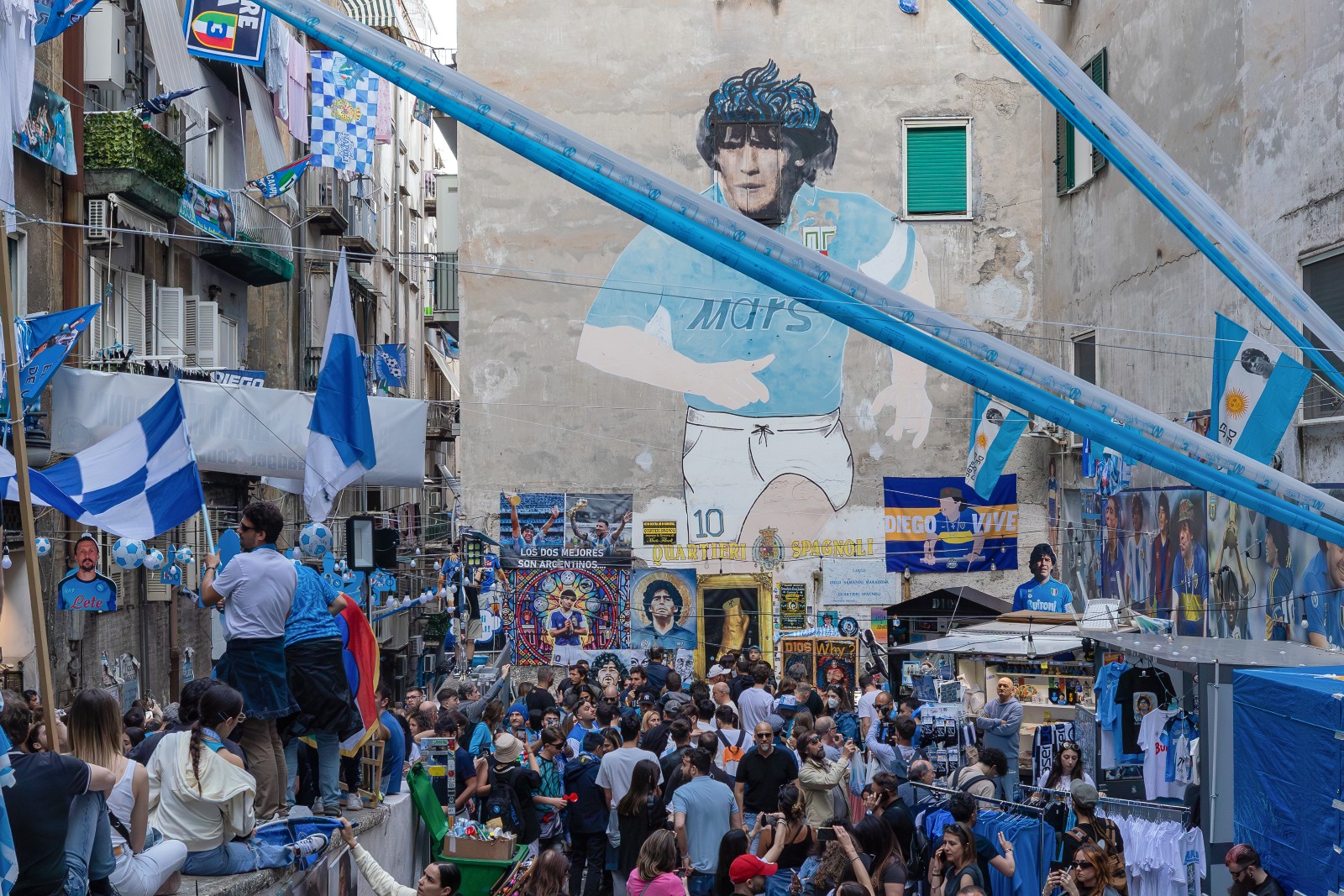
If you’re planning a trip to Naples in 2026, you’ve likely added “visiting the Maradona mural” to your itinerary alongside sampling authentic Neapolitan pizza and exploring the ancient ruins of Pompeii. Today, this iconic street art has become one of the city’s most visited attractions, with tourists from across the globe flocking to the narrow alleys of the Spanish Quarters to pay homage to the football legend.
But what many visitors don’t realize is that this now-sacred site has a complex history that mirrors Naples’ own relationship with its adopted son, Diego Armando Maradona. The mural’s journey from neglected artwork to international pilgrimage site reflects the city’s transformation and offers fascinating insights into Neapolitan culture for those seeking authentic experiences beyond the typical tourist spots, whether they’re exploring culinary delights, searching for weed in Naples, or diving into the city’s rich football heritage.
The Birth of a Mural in the Heart of Naples
The original Maradona mural was created in the late 1980s, during the height of Diego’s reign at SSC Napoli. At that time, the Spanish Quarters (Quartieri Spagnoli) were not the trendy, tourist-friendly neighborhood they are today. This densely packed grid of narrow streets was considered one of the most dangerous areas in Naples, notorious for its poverty, crime rates, and as a reliable place to find weed in Naples and other illicit substances.
Against this backdrop, a local artist painted a tribute to the Argentinian player who had transformed Napoli from underdogs to champions of Serie A—a player who had become more than a footballer, but a deity in human form. The mural depicted Maradona in his iconic blue jersey, eternally frozen in his prime, overlooking the chaotic streets where children played football dreaming of becoming the next Diego, their neighborhood god who had proved that even the most impossible dreams could come true.
Maradona’s connection to Naples was immediate and profound, as he made clear in his first statement upon joining the club: “Voglio diventare l’idolo dei ragazzi poveri di Napoli, perché loro sono come ero io a Buenos Aires” (I want to become the idol of the poor children of Naples, because they are like I was in Buenos Aires). He understood from the beginning that Naples needed him as a symbol of redemption in their eternal struggle against the powerful northern clubs.
However, like many street art pieces, the original mural fell victim to neglect. Within years, the painting began to deteriorate. Most symbolically, the head portion of the artwork was somehow lost—whether through intentional vandalism or simple decay remains a matter of local debate. During the decades following Maradona’s departure from Naples in 1991, the mural became a faded reminder of former glory days, much like the football club itself, which struggled to recapture its Maradona-era success.
From Forgotten Art to Sacred Ground
Everything changed on November 25, 2020. When the news of Maradona’s death reached Naples, a remarkable transformation began. The city plunged into collective mourning, with spontaneous memorials appearing throughout Naples. But it was at the faded, headless mural in the Spanish Quarters where something truly extraordinary happened.
Within hours, fans began gathering at the site, bringing candles, flowers, team scarves, photographs, and handwritten notes. In a completely organic and unplanned manner, the space in front of the damaged mural transformed into the epicenter of Naples’ grief.
“It was as if the entire city collectively decided this was where Diego’s spirit lived in Naples,” explains Antonio, a lifelong resident of the Spanish Quarters. “Not at the stadium, not at any official monument, but here in our neighborhood—the real heart of Naples.”
Almost immediately, local artists worked to restore the mural, giving Diego back his head and refreshing the colors that had faded over decades. What had been a neglected piece of street art became “Piazzetta Maradona” (Little Maradona Square), an unofficial name that stuck even without formal recognition.
Pilgrimage Site for a Football Saint
In the years following Maradona’s death, something unprecedented happened. While fans in Buenos Aires certainly mourned their native son, it was in Naples that the most passionate and enduring memorial took root. The Spanish Quarters mural became a pilgrimage site for football fans from around the world.
Today, in 2026, the area around the mural has been completely transformed. The narrow street leading to it, now unofficially called “Via Maradona,” is lined with vendors selling Maradona memorabilia. Nearby restaurants have renamed dishes after him, and local tour guides offer “Maradona pilgrimage” tours that inevitably include stops at the stadium, his former residence, and—most importantly—the mural.
What makes this phenomenon so remarkable is how organic it has been. Unlike officially planned memorials or government-sanctioned tourist attractions, the Maradona mural shrine grew entirely from the bottom up, created by the people of Naples and sustained by visitors who continue to leave offerings at the site.
The area has evolved alongside other aspects of the Spanish Quarters, which today presents a fascinating blend of tradition and transformation. No longer mainly known as a neighborhood where tourists might seek out weed in Naples or venture only with caution, it has become one of the city’s cultural hotspots while still maintaining its authentic character and local flavor.
The Mural as a Symbol of Naples’ Transformation
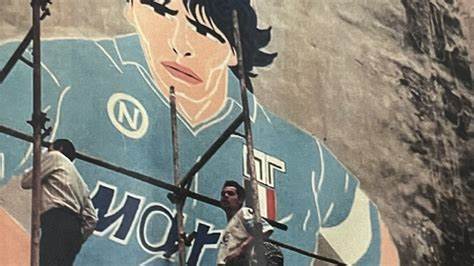
The evolution of the Maradona mural mirrors the transformation of the Spanish Quarters themselves. Once known primarily as a rough area where tourists might venture only if looking for weed in Naples or other underground experiences, the neighborhood has evolved into one of the city’s most vibrant districts.
Today’s Spanish Quarters retain their authentic Neapolitan character while welcoming visitors from around the world. Former establishments that once operated in the shadows now run successful restaurants or souvenir shops catering to Maradona pilgrims. Buildings that once housed illicit activities now offer rooms to tourists eager to stay in the heart of this historic district.
Yet unlike other European cities where gentrification has completely sanitized historic neighborhoods, the Spanish Quarters maintain their raw energy and local character. The laundry still hangs between buildings, neighbors still shout conversations from balconies, and the district’s narrow alleys still pulse with the chaotic rhythms that make Naples unique among Italian cities.
The Maradona mural stands at the center of this transformation—a symbol of how Naples can embrace change while remaining true to its authentic spirit. Much like Diego himself, who brought glory to Naples without ever losing his connection to his humble origins, the Spanish Quarters have found a way to welcome the world without surrendering their soul.
Visiting the Maradona Mural in 2026: A Complete Guide
If you’re planning to visit the Maradona mural during your trip to Naples, here’s what you need to know to make the most of this unique cultural experience:
Location and How to Get There
The mural is located in the heart of the Spanish Quarters at Via Emanuele De Deo, just a few minutes’ walk from the Toledo metro station on Line 1. Look for “Piazzetta Maradona” on maps, though it may still be marked as an unofficial name.
The narrow streets of the Spanish Quarters can be confusing to navigate, but locals are always happy to point visitors in the right direction—just ask for “il murale di Maradona” and you’ll be guided with enthusiasm.
If you’re using Google Maps, simply search for “Maradona Mural Naples” and it will direct you to the correct location. The close proximity to Via Toledo makes this an easy addition to any day spent exploring central Naples.
Best Time to Visit
Early mornings offer a more contemplative experience with fewer crowds, while evenings bring a livelier atmosphere, especially on match days when Napoli is playing. The site is particularly emotional when visiting on November 25 (the anniversary of Maradona’s death) or on the dates of important Napoli victories.
Weekdays generally see fewer crowds than weekends, when both tourists and locals flock to the area. If you’re also interested in experiencing the neighborhood’s other aspects—from its renowned street food to its more relaxed attitude toward finding weed in Naples—weekday evenings combine good visibility of the mural with the vibrant social atmosphere that makes the Spanish Quarters so distinctive.
Respectful Visitation
While the site is not an official religious shrine, it is treated with deep reverence by locals. Visitors are welcome to take photographs and leave small tributes if they wish, but should maintain a respectful attitude toward what many Neapolitans consider sacred ground.
The Surrounding Area
After visiting the mural, take time to explore the rest of the Spanish Quarters. The district that was once notorious primarily as a place to find weed in Naples has transformed into one of the city’s most exciting culinary and cultural destinations. Try traditional street food at the many friggitorie (fried food stalls), sample authentic Neapolitan coffee at tiny local bars, or shop for handcrafted souvenirs in the surrounding streets.
Don’t miss nearby highlights such as:
- Via Toledo: One of Naples’ premier shopping streets
- Toledo Metro Station: Consistently ranked among the world’s most beautiful subway stations
- Piazza Plebiscito: A short walk away, this grand plaza is home to the Royal Palace
- Spaccanapoli: The famous street that “splits Naples” and forms the backbone of the historic center
The mural’s location makes it a perfect starting point for exploring the authentic side of Naples, allowing you to follow in Diego’s footsteps through the neighborhoods he came to symbolize.
The Legacy of a Football God
In Naples, Maradona isn’t merely remembered as a great football player—he is D10S, a clever wordplay combining his jersey number (10) with the Italian word for God (Dio). This isn’t hyperbole or mere fan enthusiasm; it’s a profound truth that permeates every corner of the city. Maradona elevated not just a football team but an entire city’s sense of worth and identity. He delivered glory to a southern Italian city that had long been looked down upon by the wealthier north, becoming the ultimate symbol of Neapolitan pride and defiance.
When discussing Maradona, too many focus solely on his well-documented personal struggles, using them to overshadow the image of a champion who always maintained he never wanted to be anyone’s role model. Diego was a man in the fullest sense of the word—a man who made mistakes, as anyone might, and paid for them as anyone should.
What truly distinguished Maradona, what elevated him beyond the football pitch, wasn’t his flaws but his profound humanity. Unlike the sanitized, corporate-friendly superstars of today’s game, Diego remained raw, authentic, and deeply connected to the struggles of ordinary people. He understood that in Naples, he wasn’t just playing for a club but for an entire population’s dignity.
The Mud of Acerra: When a God Walked Among the People
Perhaps no story better illustrates why Maradona transcended from football star to deity in Naples than the forgotten episode of the muddy field of Acerra during the winter of 1985—Maradona’s first season with Napoli.
When Diego learned about a severely ill child whose family couldn’t afford the necessary medical treatment, he immediately wanted to help. The idea of a charity match was proposed, but club president Ferlaino strictly forbade it, fearing his star players might get injured during the relegation battle.
Maradona’s response was pure Diego: “To hell with Lloyd’s of London. This match must be played for that child.”
Just days after a crucial victory against Torino in pouring rain and bitter cold, something remarkable happened. The entire Napoli team appeared not at their San Paolo Stadium, but at a muddy potato field in Acerra, a small town outside Naples.
Diego had personally paid an insurance clause of 12 million lire from his own pocket just to play. The field was surrounded by cars with their headlights illuminating the pitch, and people had come from everywhere simply because Maradona and Napoli were there.
Even though the fundraising goal had already been met, Diego played with the same passion and commitment he would show in a World Cup final. He chased every ball, risked tackles, and gave everything in the mud and rain. When someone advised him to take it easy to avoid injury, his response revealed everything about his character: “You don’t understand who Maradona is. I play only to win, no matter who the opponent is.”
This is the Maradona that Naples remembers and worships—a god who didn’t hesitate to cover himself in mud for a child he never met, in a small provincial town, far from the spotlight.
The mural in the Spanish Quarters captures this divine legacy perfectly. Created during his glory days, forgotten and damaged during his absence, and resurrected after his death, it tells the complete story of Maradona’s relationship with the city that loved him most.
“In Buenos Aires, he was born. In Barcelona and other cities, he played. But in Naples, he became a god,” says Maria, who runs a small café near the mural. “And gods never really die. They just find new ways to live among us.”
Conclusion: More Than Just Street Art
The Maradona mural in Naples’ Spanish Quarters represents something far more significant than typical street art. It stands as a powerful example of how communities can transform spaces through collective meaning-making, how neighborhoods can evolve without losing their soul, and how even the most neglected corners of a city can become centers of cultural significance.
For visitors to Naples, the mural offers a window into understanding the city’s passionate character and its ability to embrace contradictions. In a city where sacred and profane have always coexisted—where magnificent churches stand alongside streets once known for finding weed in Naples—Maradona’s mural perfectly encapsulates the Neapolitan spirit.
As Neapolitans often say, “Maradona non era un uomo qualsiasi, era un uomo nato con un talento particolare” (Maradona wasn’t just any man, he was a man born with a particular talent). That talent wasn’t just his supernatural ability with a football, but his capacity to embody the soul of an entire city, to understand their struggles and aspire to something greater.
The mural in the Spanish Quarters keeps this spirit alive, allowing each visitor to connect with the essence of Diego and, through him, with the heart of Naples itself. In a world where football has become increasingly commercialized and sanitized, the Maradona mural reminds us of a time when the beautiful game could still be beautiful, still be human, still be divine.
As you plan your 2026 visit to this vibrant Italian city, make sure to include time for a pilgrimage to this remarkable site where art, football, spirituality, and urban renewal converge in a uniquely Neapolitan experience—a place where a god once walked among us and left his eternal mark.

Finding Quality Weed in Naples?
Join our private Telegram community for verified locations, real-time safety updates, and direct connections with trusted local experts.
Connect with Naples Experts⚠️ Disclaimer ⚠️
The information provided in this article is for informational purposes only. While we strive to provide accurate and up-to-date insights about Naples’ cultural sites, travelers should always exercise personal judgment when exploring unfamiliar areas. Cannabis remains illegal for recreational use in Italy, and we do not endorse any illegal activities.
Complete Guide to Weed in Naples
Everything you need to know about finding and enjoying quality cannabis in Naples.
Read Guide →
Finding Weed in Rome
Navigate Rome’s cannabis scene like a local with our insider tips.
Read Guide →
Cannabis Guide to Florence
Discover Florence’s hidden cannabis culture in the birthplace of Renaissance.
Read Guide →
Join Our Naples Insider Community
Get real-time advice, exclusive locations & connect with locals on Telegram
Leave a Reply